


Start Strong. Stay Aligned.
A structured way for new or newly formed teams to establish clarity, align early, and build momentum from the beginning.
Most teams wait for problems to appear before addressing how they work together.
Fast Start helps teams get aligned from the start — before misalignment creates friction.

Alignment is often left to chance
When a team forms, there is usually immediate focus on:
Deliverables
Timelines
Responsibilities
But very little time is spent clarifying how the team will actually work together.

As a result:
Roles evolve inconsistently
Decision-making becomes unclear
Meetings lack structure
Expectations remain unspoken
These issues often don’t show up immediately—but they almost always show up later.

Build alignment early
Fast Start uses the 8 Conversations to help teams establish clarity from the beginning.
Instead of reacting to problems later, teams proactively define:
How they work
How decisions are made
How responsibilities are structured
How they coordinate and communicate

A structured working session
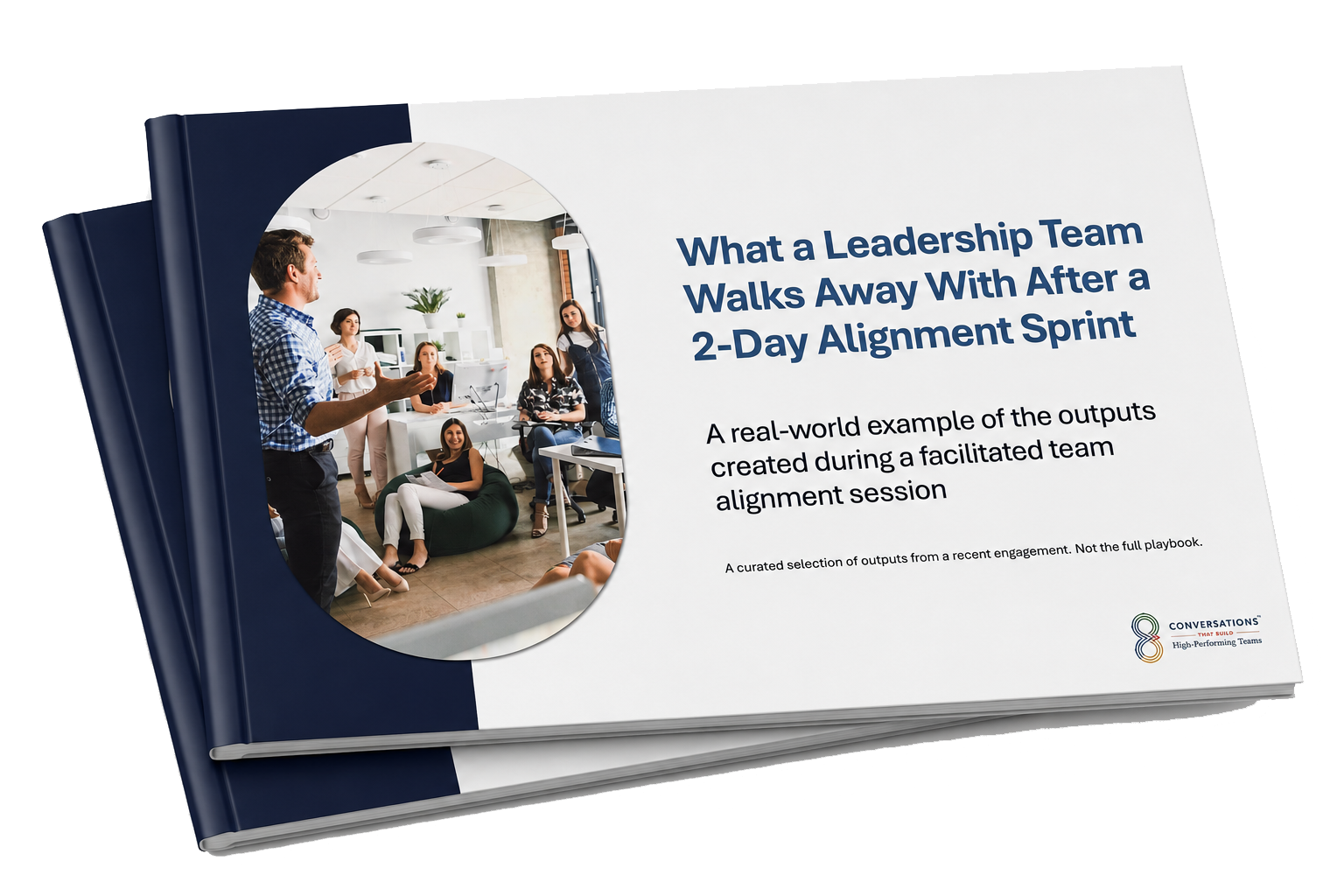
Fast Start is typically delivered as a facilitated session over one or two days. During the session, the team works through the 8 Conversations together—producing practical outputs in real time.
What the team does:
Aligns on purpose and priorities
Defines roles and ownership
Establishes decision-making expectations
Designs meeting and communication structure
Agrees on team principles and behaviors
Teams typically see immediate improvements in decision speed, clarity of ownership, and meeting effectiveness—immediately after the session.

Clarity the team can use immediately
The outputs from Fast Start are captured in a Performance Ready Playbook.
This includes:
Team purpose and priorities
Clear role ownership
Decision framework
Operating rhythm
Team principles and expectations
These outputs provide a shared reference that supports execution from day one.
Fast Start
Fast Start is most valuable when
-

A new team is forming
-
A team has been recently restructured
-

Leadership roles are changing
-

Responsibilities are evolving
-
A team wants to avoid future misalignment
Clarity early prevents friction later
-

Most team challenges are predictable.
-

They emerge when expectations are unclear and assumptions go unspoken.
-

Fast Start makes those expectations explicit—before they become problems.
-

Most teams don’t intentionally design how they work—they inherit it.

Build alignment before it becomes a problem
Build alignment before it becomes a problem