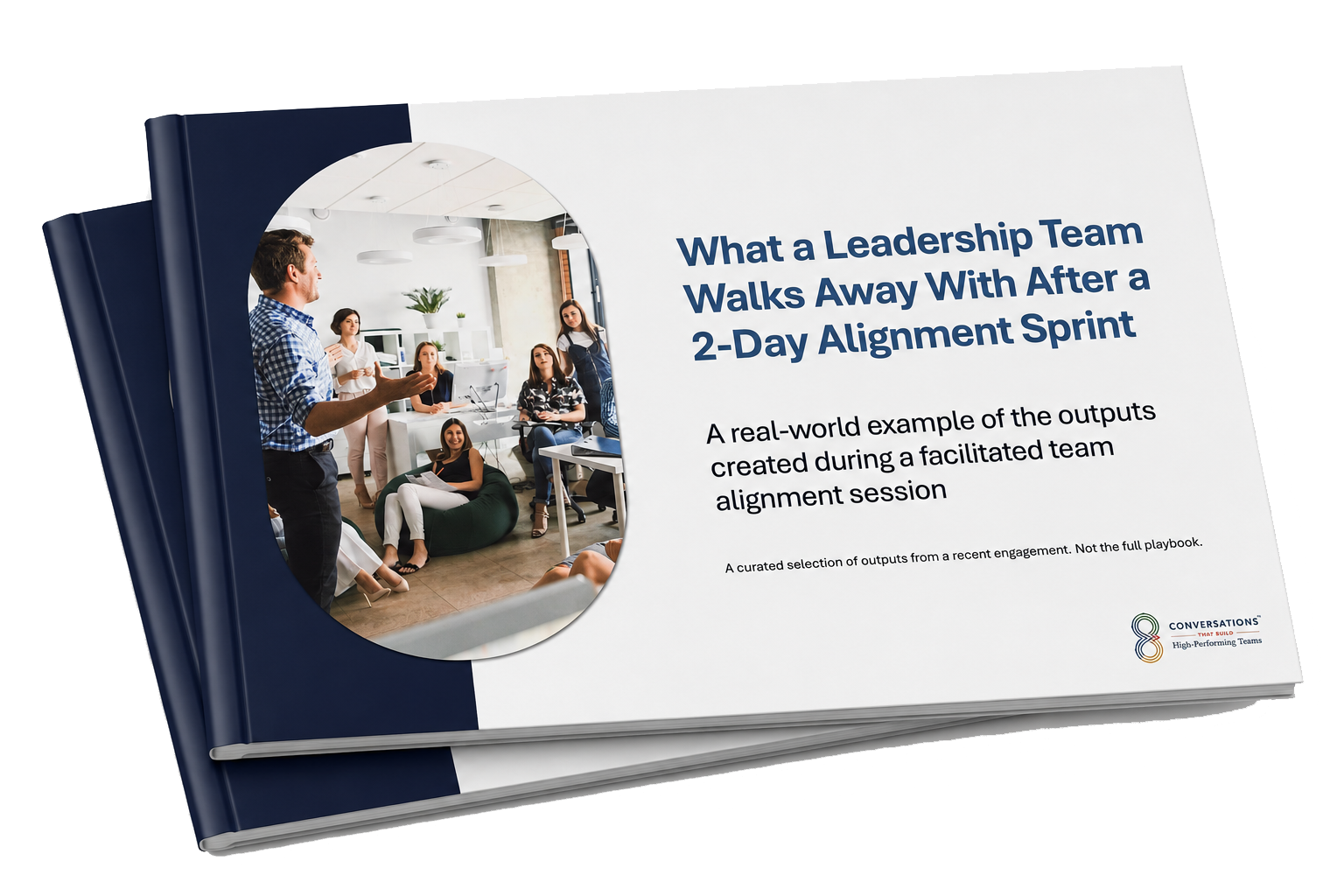

Reset How Your Team Works
A structured way to address misalignment, improve decision-making, and restore momentum.
When teams are not aligned, work feels harder than it should. Rapid Reset is designed for teams that are capable—but not fully aligned.

When alignment breaks down, performance follows
Most teams don’t fail all at once. They experience small breakdowns that compound over time.
You may notice:
decisions getting revisited
unclear ownership
competing priorities
meetings that don’t move work forward
frustration across functions
tension that isn’t addressed directly
Individually, these seem manageable. Together, they slow the team down. The same conversations happen repeatedly. Decisions take longer than they should. And progress depends more on individual effort than clear alignment.
At some point, the cost of working this way becomes impossible to ignore.


Identify and address the sources of friction
Rapid Reset uses the 8 Conversations to surface where alignment has broken down—and to restore clarity quickly.
Instead of working around issues, teams address:
where ownership is unclear
where decisions stall
where priorities compete
where expectations are misaligned
The focus is on creating clarity that improves coordination and execution.

A focused working session
Rapid Reset is typically delivered as a facilitated session over one or two days. The team works through the most relevant conversations based on where alignment is breaking down.
What the team does
clarifies roles and responsibilities
improves decision-making clarity
aligns on priorities
redesigns meeting and communication structure
addresses sources of friction directly
Teams typically see immediate improvements in decision speed, clarity of ownership, and meeting effectiveness — immediately after the session.


Clarity that removes friction
The outputs from Rapid Reset are captured in a Performance Ready Playbook.
This includes:
clarified roles and ownership
decision framework
aligned priorities
improved operating rhythm
shared expectations for how the team works
These outputs help teams move forward with greater clarity and consistency.

When teams use Rapid Reset
Rapid Reset is most valuable when:
coordination feels harder than it should
decisions are slow or frequently revisited
roles and ownership are unclear
priorities feel misaligned
meetings are not effective
tension exists but is not addressed directly
Most teams don’t fix these issues—they adapt around them, and the cost shows up in slower decisions, repeated work, and unnecessary frustration.

Rapid Reset is most valuable when
-

A new team is forming
-

A team has been recently restructured
-

Leadership roles are changing
-

Responsibilities are evolving
-
A team wants to avoid future misalignment
Addressing issues directly creates momentum
-

Most teams attempt to work around friction.
-

Rapid Reset creates space to address it directly.
-

By making expectations explicit and clarifying how the team operates, alignment is restored—and work moves forward more effectively.
-

Most teams already know something isn’t working—they just haven’t created the space to fix it.